
🔺👁️🔺🐸 NEW CULTFROGGY RELEASE - Drum and Bugle Corps Is a Cult 🐸🔺👁️🔺
- Edward Francis
- Apr 18
- 22 min read

Greetings Dear Friends,
Before you dive into the article below, a few words.
If you caught the latest episode of CultFroggy — which dropped on April 16th — you already know where this is going.
If you haven't watched it yet, you can find it right here: https://youtu.be/dSJ922GhKsA?si=kUNW86D7A-UrR60i
Go watch it. Then come back. The article will still be here.
What follows is the full written companion piece to that episode: Drum and Bugle Corps Is a Cult, a deep analytical dive into the psychological architecture of competitive drum corps using the frameworks of Robert Jay Lifton, Steven Hassan, and Margaret Singer. We're talking Milieu Control, the BITE Model, thought-terminating clichés, the "Superman Mode" nervous system hijack, financial exploitation, documented abuse, and the very specific way these organizations erase the people who dare to speak up about any of it. It is not a light read. It is not meant to be.
Here's the thing about this episode and this article that makes them different from a lot of cult analysis you'll find out there: this isn't academic distance. This is personal.
I have spent my entire life inside high-control environments — not one, not two, but across virtually every major chapter of my life. Family. Religion. Education. Performance. The workplace. That pattern is the foundation of my upcoming memoir series, The 7 Series, three interconnected books that trace the architecture of control across the spaces I've lived in and the institutions I've moved through. 7 Rooms examines the family and home dynamics that first taught me what control looks like. 7 Houses follows the pattern outward, through the other high-demand environments that shaped — and tried to reshape — who I am. 7 Fields goes deep into the marching arts specifically, drawing on my own history as a performer and the post-corps reckoning that followed.
Drum corps isn't a detour in that story. It's a chapter. And after decades of living inside systems designed to make you stop asking questions, I've gotten very good at asking them.

I also want to be transparent with you all about where things stand on my end.
I'm a little behind, and you deserve to know why. My father passed away recently, and in addition to grieving that — which is its own complicated thing — I've been helping manage his estate while also working a part-time job and keeping both CineMarch Media podcasts running. It's a lot of plates, and I won't pretend otherwise.
Your patience during this time has meant more than I can say. I'm catching up, I'm still here, and the work is still getting done. Just maybe not always on the schedule I'd like.
Thank you. Genuinely. Now go read the article.
— Edward Michael Francis (they/them) CineMarch Media, LLC www.cinemarchmedia.com
Drum and Bugle Corps Is a Cult
By Edward Michael Francis (they/them)
CultFroggy
The psychological landscape of high-demand groups is defined by a sophisticated interplay of environmental control, cognitive restructuring, and emotional manipulation. While the term cult is often colloquially reserved for fringe religious sects, the underlying architecture of totalism—the systematic attempt to dominate human thought and behavior—is observed across a wide spectrum of contemporary organizations, including political movements, corporate entities, and elite youth performance activities. To understand the depth of these dynamics, one must examine the seminal frameworks established by psychiatrist Robert Jay Lifton, social psychologist Steven Hassan, and psychologist Margaret Singer. These three models provide a robust lens through which to analyze how groups achieve "thought reform," a process by which an individual’s authentic identity is suppressed and replaced by an artificial, group-aligned persona. By grounding these theoretical constructs in the specific case of competitive drum and bugle corps, a multi-million dollar youth performance activity, the mechanisms of undue influence become clear, revealing a system that prioritizes organizational doctrine over individual well-being.
The Foundations of Totalism: Robert Jay Lifton’s Eight Criteria
The academic study of modern thought reform began with Robert Jay Lifton’s investigation into the techniques used by Chinese communists in the mid-twentieth century to facilitate drastic shifts in personality and belief systems. Lifton identified eight specific criteria that characterize a totalist environment, where the group or its leadership seeks to control not only the external behavior of members but also their internal communication with themselves. The first and most foundational of these criteria is Milieu Control, which involves the strict regulation of information and communication both within the environment and, ultimately, within the individual. This creates a state of psychological and social isolation, cutting the member off from the broader society and making it difficult to maintain a separate identity. In the world of Drum Corps International, this control is exercised through the "closed ecosystem" of a summer tour, where members spend months on buses and in gymnasium floors with little to no access to the outside world.
Following Milieu Control is Mystical Manipulation, a process where the group orchestrates experiences that appear spontaneous or divine but are actually designed to reinforce the authority of the leadership. In performance environments, this often manifests as the reframing of extreme physical suffering or "divine" breakthroughs on the rehearsal field as evidence of the system’s effectiveness. This is inextricably linked to the Demand for Purity, where the world is viewed in absolute, black-and-white terms. Members are constantly exhorted to strive for an unattainable perfection, and the inevitable failure to reach this standard is used to induce guilt and shame, which are powerful tools for maintaining compliance. The group defines "sin" as anything that deviates from the collective goal, leading to the criterion of the Cult of Confession. In this dynamic, members must publicly divulge their "sins," "attitudes," or "faults" in group settings, where they are exploited by leadership to reinforce group identity and peer-level surveillance. Many times the confession becomes automatic and self-policing. Members are often encouraged to do push-ups, laps, or otherwise punish themselves physically when committing a mistake.
The remaining four criteria—Sacred Science, Loaded Language, Doctrine Over Person, and the Dispensing of Existence—form the cognitive and social walls of the totalist system. Sacred Science posits that the group’s doctrine is the ultimate Truth, beyond all questioning or dispute, and that this Truth is not to be found elsewhere. In the competitive landscape of drum corps, this manifests as a "brand-exclusivity" where each individual corps presents its specific culture and methodology as the definitive pinnacle of the activity. Members are conditioned to believe that their specific corps provides the "best" or "only" valid experience, rendering the internal processes of the group beyond critique. Questioning the "process" or the leadership is thus framed as a failure of character rather than a valid critique. This is facilitated by Loaded Language, the use of specialized jargon and "thought-terminating clichés" that compress complex human problems into reductive, easily memorized phrases. This jargon, which includes terms like "SUTA" or "Splooie" in drum corps, serves to alter the way members think and speak, further isolating them from those who do not understand the group’s shorthand.
Doctrine Over Person dictates that an individual’s personal experiences are subordinate to the group's "science," requiring them to deny or reinterpret any experiences that contradict the group ideology. Finally, the Dispensing of Existence grants the group the prerogative to decide who has the right to "exist" or be valued. In the junior corps model, the mandatory "aging out" process often functions as the spiritual death of the member; once an individual no longer serves the collective’s competitive or aesthetic needs, their previous years of devotion are effectively nullified by the system. This creates a bizarre incentive for junior groups to actively discount or mock "senior" or all-age corps, as the existence of a lifelong performance outlet threatens the aging-out mythos. By devaluing any participation beyond the junior level or outside their specific organization, the group ensures that those who leave, criticize, or simply age out are erased, losing all credibility and "being" in the eyes of those remaining within the system.
Table 1: Comparative Functional Summary of Lifton’s Eight Criteria
Criterion | Functional Mechanism | Objective |
Milieu Control | Regulation of communication and information. | Psychological and social isolation. |
Mystical Manipulation | Orchestration of "spontaneous" experiences. | Demonstration of divine or exceptional authority. |
Demand for Purity | Categorization of existence into black and white. | Induction of guilt and shame for control. |
Cult of Confession | Forced disclosure of sins and faults. | Exploitation of vulnerability for group identity. |
Sacred Science | Framing doctrine as the ultimate truth. | Elimination of questioning and critical thought. |
Loaded Language | Use of thought-terminating clichés and jargon. | Reduction of complex problems to group phrases. |
Doctrine Over Person | Subordination of individual experience to doctrine. | Denial or reinterpretation of contradictory facts. |
Dispensing of Existence | Devaluation of those outside or critical of the group. Aging out acts as the spiritual death for World Class Junior Corps. | Erasure of dissent and credibility of outsiders. |
The BITE Model: Steven Hassan’s Taxonomy of Authoritarian Control
While Lifton’s model focuses on the ideological and communication-based aspects of thought reform, Steven Hassan’s BITE model provides a more concrete, behavioral framework for assessing "undue influence." Developed in the 1980s and refined through decades of work with former cult members, the BITE model categorizes control into four overlapping components: Behavior, Information, Thought, and Emotional control. This model is grounded in Leon Festinger’s theory of cognitive dissonance, which suggests that if an influencer can get a person to act in certain ways (Behavior), their private beliefs (Thought) and feelings (Emotion) will eventually shift to remain congruent with those actions.
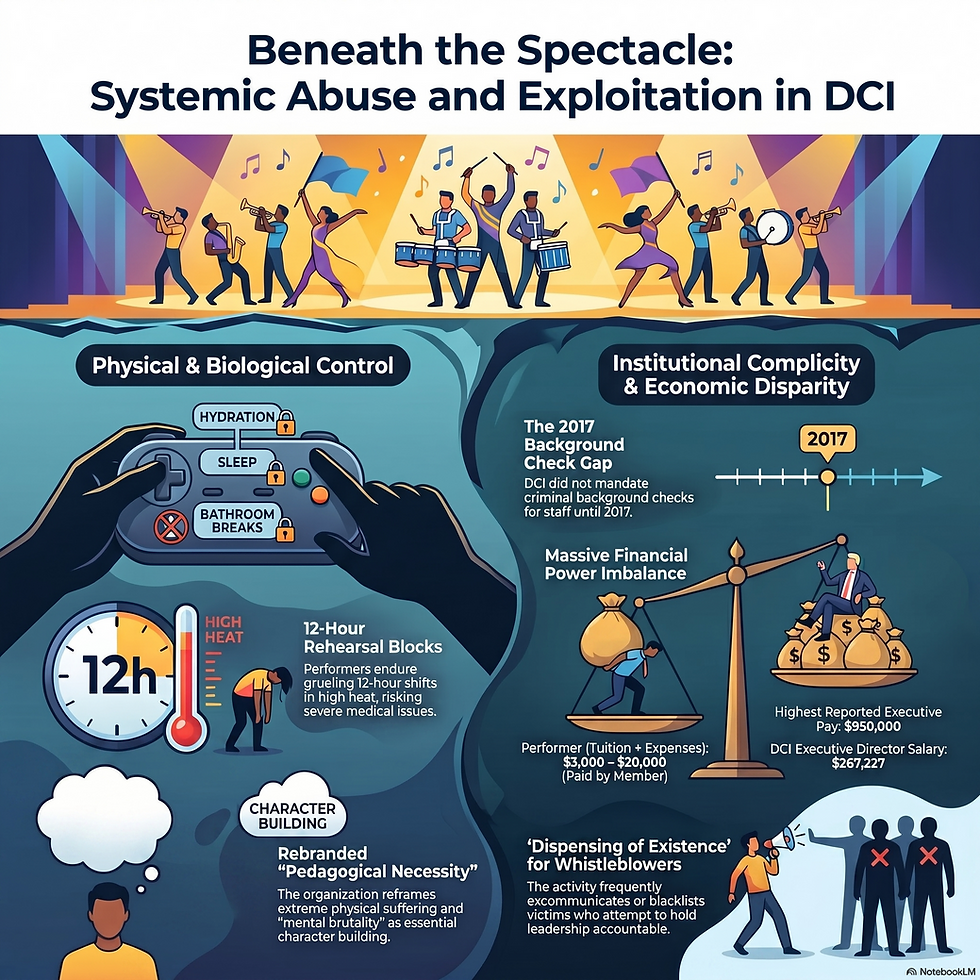
Behavioral Control involves the regulation of an individual’s physical reality to instill dependency and obedience. This includes dictating clothing, hair styles, food, and housing, as well as the implementation of rigid rules and regulations. In high-demand performance groups, behavior control is evident in the 12-hour rehearsal blocks in extreme heat, limited access to water, and severe sleep deprivation, often totaling only five or six hours of rest on gymnasium floors. This regulation extends to the most basic physical needs, including the strict monitoring and restriction of bathroom access. Furthermore, the organization co-opts social bonds through the implementation of "buddy systems" and pseudo-family structures, such as "big brothers" or "big sisters." While framed as essential measures for safety and mentorship, these roles function as a sophisticated layer of horizontal surveillance. By assigning a senior member to oversee a newcomer, the group creates an immediate emotional debt and a 24/7 monitoring loop, where any deviation from the rules is felt as a personal betrayal of a "sibling" rather than a critique of the institution. Participants are thus encouraged to "spy" on one another and report deviations to superiors, ensuring the group always comes before the self.
Information Control is the second pillar, where the organization uses deception by lying, withholding, or distorting information to make its agenda appear more acceptable. In a modern context, this control often moves beyond simple censorship to the more subtle regulation of the "interpretive lens" through which a member views the world. It is not merely that a member’s information intake is restricted, but that their thoughts around that information—the very framework used to process reality—are strictly controlled. When outside information or criticism does reach a member, they have already been equipped with internal defense mechanisms and "authorized" explanations that allow them to dismiss or reframe the data to fit the group’s interests. This ensures that even when exposed to the "outside world," the member remains psychologically insulated, viewing all external reality through the distorting filter of the organization’s ideology.
Thought Control and Emotional Control complete the BITE model. Thought control utilizes techniques like "thought-stopping"—the use of chanting, meditation, or repetitive tasks—to block out critical thoughts or doubts about the leadership. In a drum corps setting, the constant, high-volume repetition of music and drill acts as a physiological thought-stopping mechanism, inducing a "trance-like" state that makes performers more suggestible. Emotional control manipulates the internal feelings of members, using fear of the outside world or the threat of being "cast out" to ensure compliance. A critical part of this process is the "refreezing" step, where the member’s past life and identity are denigrated, making them feel that they only have worth within the context of the group.
Margaret Singer’s Six Conditions: Environmental and Social Engineering
Margaret Singer’s framework shifts the focus to the specific conditions of the social and physical environment that allow a thought reform system to take place. Singer emphasized that the process is often a "step-by-step" behavioral-change program where potential members are kept unaware of the final agenda or the ways in which they are being changed.
Her first condition is to keep the person unaware of the full content of the group and how they are being transformed into "deployable agents" for the leadership. The second condition involves the control of the person’s social and physical environment, specifically their time.
By keeping members constantly busy and exhausted, the group ensures that their waking hours are entirely consumed by group content, leaving no room for reflection. The third condition focuses on creating a systematic sense of powerlessness. This is achieved by isolating members from their normal support groups—friends, family, and former occupations—and placing them in an environment where everyone else is already a group member who models group-approved behaviors and uses group language. This isolation erodes the individual's confidence in their own perceptions and erodes their former identity. The fourth and fifth conditions involve the manipulation of rewards and punishments to inhibit behavior that reflects the old identity and promote the learning of group-approved behaviors.
Questioning or doubting is met with disapproval or rejection, while compliance is rewarded with affection and esteem from peers. Finally, the sixth condition is the implementation of a closed system of logic and an authoritarian structure that refuses to be modified except by leadership approval. In this top-down hierarchy, the individual is always wrong, and the system is always right; if a member complains, it is framed as a personal defect rather than a flaw in the organization.
Table 2: Mapping of Theoretical Models to Organizational Mechanisms
Concept | Lifton (8 Criteria) | Hassan (BITE) | Singer (6 Conditions) |
Physical Isolation | Milieu Control | Behavior Control | Environment Control |
Elite Language | Loaded Language | Thought Control | In-group Language |
Indoctrination | Sacred Science | Information Control | Learning Ideology |
Identity Erasure | Doctrine Over Person | Emotional Control | Inhibiting Former Identity |
Hierarchy | Dispensing Existence | Behavior Control | Authoritarian Structure |

The Grounding Case Study: Drum Corps as a High-Demand Performance Environment
The theoretical frameworks of Lifton, Hassan, and Singer provide a comprehensive explanation for the high-control dynamics observed in competitive drum and bugle corps. While the activity is sold to the public as a "wholesome" youth development program, the internal reality often matches the criteria for a totalist system. The author Edward Michael Francis notes that "drum corps matches every criterion laid out by psychiatrist Robert Jay Lifton". The activity functions as a closed ecosystem during the summer tour, where milieu control is exercised through 24-hour proximity to the group and isolation from outside perspectives.
Behavioral control is perhaps the most visible aspect of the drum corps experience. Members endure "brutality of a mental nature," including sleep deprivation and exclusion from social contact. The physical demands are intense, with 12-hour rehearsal blocks in high heat and humidity, which research has shown puts marching artists at high risk for medical and mental health problems, including anxiety, stress, and eating disorders. These conditions are not merely side effects of "excellence" but function as a method to "break a person down" (unfreezing) before introducing the group's indoctrination.
Bodily functions are subjected to rigorous peer and staff enforcement. On the bus, bathroom use is often highly restricted, with social pressure dictating that members should only urinate to avoid creating unpleasant odors in the living space; those sitting in the back of the bus are often designated as responsible for ensuring the restroom remains closed at all times.
During rehearsals, bathroom time is closely monitored by section leaders or "leads," and taking longer than the group deems appropriate can result in being "spoken to" or disciplined for a lack of commitment. The financial exploitation of members is also significant; performers pay between $3,000 and $20,000 in tuition and travel costs to provide what is essentially full-time, unpaid labor that generates millions in revenue through ticket sales and media subscriptions.
Table 3: Economic Disparities in Performance Organizations (2023-2024 Data)
Role | Financial Commitment or Compensation |
Member Tuition + Expenses | $3,000 - $20,000 per season |
DCI Executive Director Salary | $267,227 |
DCI Chief Operating Officer | $175,423 |
Average Executive Compensation | $237,751 |
Highest Reported Executive Compensation | $950,000 |
The Architecture of Physical and Sexual Violence
While the public-facing image of the marching arts is one of discipline and "wholesome" youth development, the high-control architecture of the activity has frequently provided cover for systemic physical and sexual violence. Because these organizations operate as closed ecosystems with extreme hierarchical power imbalances, survivors are often groomed to believe that abuse is either a "pedagogical necessity" or a "tradition" they must endure for the sake of the collective.
Reported Sexual Violence and Institutional Complicity
Documented accounts reveal a harrowing history of sexual assault perpetrated by staff and older members against minors and young adults.
One survivor reported being chased into a locker room by a fellow member at age 11 and held in a chokehold while being touched inappropriately; when reported, the caption head merely made the person who caused harm "run a lap".
Another account details a 14-year-old waking up on a tour bus to find their 17-year-old seat partner’s hand in their shorts. Staff reportedly brushed off the complaint and refused to allow the survivor to change seats.
A former member of <REDACTED> recalled a main horn instructor in his 60s suddenly lying on top of them on a gym floor, tickling and groping them. When the director was informed, he gaslit the survivor, suggesting their "religious upbringing" made them too "conservative" and stated that because the survivor pushed him off, "nothing happened".
The "Broken Silence" investigations further uncovered a culture of "institutional sexual abuse" where survivors were routinely told to "get over it" by those in power.
At <REDACTED>, professional boundaries dissolved almost immediately after a staff coordinator learned a designer was gay, leading to flirtatious and predatory communication. During an open house, this coordinator lured the designer into a classroom under the guise of business and used his position of power to coerce them into providing manual stimulation. The survivor felt compelled to comply out of a survival-based need to keep their job.
A 2024 uniform manager at <REDACTED> reported being sexually assaulted while on tour. Despite turning to leadership for support, the survivor was met with months of silence regarding their request for help with legal proceedings and pressing charges. Furthermore, leadership allegedly violated the survivor's privacy by sharing sensitive details of the assault with unauthorized staff members.
Physical Abuse, Hazing, and Degradation
Physical violence and biological regulation are frequently rebranded as "mental fortitude".
Instructors have been reported for physically striking members, including one percussion caption head who slapped the face of every snare player before a show. When parents complained, a donor reportedly gathered the corps to call the members "pussies" for reporting the assault.
At <REDACTED>, the environment was described as "brutality of a mental nature," involving members being "ripped out of bed" while sleeping to be screamed at by the entire corps staff for involving parents in a medical emergency.
Other reported rituals include "compliance training" where instructors would walk around members standing at attention, whispering "erotic comments" into the ears of 15-year-olds for 15 minutes at a time to test their flinch response.
Members have reported being forced into "quasi-rape fantasy" rituals, such as "Rookie Talent Nights" involving "the bung"—a story members were pressured to read aloud—or events where adults performed sexual acts and urinated in front of minors. Those who refused were subjected to mockery and endless physical punishment for "disobeying".
Biological needs are weaponized; one survivor at <REDACTED> was berated for taking a bathroom break during an asthma attack, while another member at <REDACTED> was forced to urinate on themselves on the field because staff refused to let them leave the block.
Ableism, Retaliation, and the "Dispensing of Existence"
The final wall of the totalist system is the systematic silencing and discrediting of those who speak out.
A uniform manager at <REDACTED> reported that a member of the organization demeaned their autism, using slurs and labeling them "disrespectful." When reported, leadership reportedly defended the individual and elevated them to a higher position of power.
Survivors report being ostracized by directors and told they were "not a <REDACTED>" for attempting to set boundaries or leave toxic situations. This often involves stripping members of symbols of belonging, such as "triangles" or corps necklaces, to effectively erase their identity within the group.
Retaliation for reporting misconduct can include "whisper campaigns" designed to socially isolate the individual by labeling them "not committed" or "lacking resilience".
This institutional silence and the refusal to implement true accountability protects the "sacred science" of the organization at the direct expense of the safety and autonomy of the young performers it claims to serve.
Physical Abuse and Degradation
Physical violence and biological regulation are frequently rebranded as "mental fortitude".
Initiation rituals extend beyond psychological humiliation into overt physical violation. Edward Michael Francis, the author of this paper and a former member of the Caballeros Drum and Bugle Corps, recounts their rookie initiation as follows: during a moving tour bus ride, new members were required to strip naked and run the length of the aisle while being spanked by veteran members. The ritual was presented as a rite of passage — a celebration of belonging — while functioning structurally as a hazing event that used physical vulnerability, public nudity, and corporal contact to establish the hierarchy between veterans and rookies. The normalization of this experience as "tradition" is a textbook example of Singer's fourth condition: the use of reward and punishment to suppress former identity and enforce group-approved behavior. The rookie who endures the ritual is not merely hazed — they are inducted into a system of silence, having now participated in the very mechanism that will be used on the next generation.
Other reported rituals include "compliance training" where instructors would walk around members standing at attention, whispering "erotic comments" into the ears of 15-year-olds for 15 minutes at a time to test their flinch response.
Members have reported being forced into "quasi-rape fantasy" rituals, such as being pressured to read sexually violent stories aloud to the group; those who refused were subjected to endless physical punishment for "disobeying".
The "Dispensing of Existence" for Whistleblowers
The final wall of the totalist system is the systematic silencing of those who speak out. In the marching arts, this often takes the form of blacklisting, public shaming, or "whisper campaigns" designed to socially isolate the individual. Survivors report being ostracized by directors and told they were "not a <REDACTED>" for attempting to set boundaries or leave toxic situations. This institutional silence protects the "sacred science" of the organization at the direct expense of the children and young adults it claims to serve.
Cognitive and Emotional Control Mechanisms in the Field
The control of thought and emotion in high-demand performance groups is maintained through a combination of "sacred science" and "loaded language." In drum corps, the "science" is the design and execution of the show, which is treated as gospel. Designers and arrangers are often revered as "near-religious figures," and their creative choices are considered "sacred law". The "Six Words" mantra of the Bluecoats or the "SUTA" acronym of Phantom Regiment act as secret rallying cries that permeate the culture and catalyze a specific work ethic. While members often debate the "secret" meanings of these terms, their functional role is to provide a sense of elite insider status and to stop critical questioning of the system's demands.
Critical thinking in these environments is often actively suppressed through "thought-terminating clichés." Lifton defined these as brief, highly reductive, definitive-sounding phrases that are easily memorized and expressed, serving to compress complex human problems and end any ideological analysis. In a drum corps setting, phrases such as "trust the process" or "trust the staff" are used to stop members from questioning authoritarian demands or unsafe conditions. Mantras like "it is what it is" or "you get out what you put in" rationalize extreme suffering, while the dismissive "you knew what you signed up for" is used to silence dissent by framing legitimate grievances as a failure of the individual to accept the system's terms. Other examples of "loaded" clichés include educational jargon like "maximizing potential," "mental fortitude," or "feedback culture," which rebrand degradation as pedagogical necessity. These phrases function as cognitive "stops," protecting the group's reality from the intrusion of individual doubt or external critique.
Term | Alleged or Rumored Meanings | Control Function |
SUTA | "Set Up The Arc," "Spirit Up The A—" | Reinforces secret knowledge and hierarchy. |
Splooie | "Spirit Pride Loyalty Obligation Integrity Excellence" | Creates a linguistic barrier for non-members. |
FHNSAB / WALSTF / MYNWA / SITC | "For Holy Name Shall Always Be" (Cadets)“When Autumn Leaves Start to Fall” (Bluecoats) “May You Never Walk Alone” (Scouts), “Send in the Clowns” (SCV) | Ties current members to a "sacred" historical legacy. |
Tour/Bus Goggles | Psychological filter for attraction | Rationalizes distorted perceptions under stress. |
Superman Mode | Peak performance; total mental toughness; being "invincible." | Creates dissociation in the brain that enables the member to |
Gush and Go | Running to the sideline for water and returning to the set immediately. | Chronic Arousal: Prevents the parasympathetic nervous system from engaging; keeps the heart rate high and the brain in "survival" mode. |
Full Out | Giving 100% effort until physical collapse. | Cognitive Bypass: Rationalizes the total surrender of physical boundaries, framing potential injury as a "pedagogical necessity." |
This linguistic control is deepened by a physiological state often celebrated in the activity as "Superman Mode." While presented as the ultimate manifestation of "mental toughness," it is actually a sustained sympathetic nervous system hijack. Under conditions of chronic sleep deprivation, heat, and caloric deficit, the brain enters a state of transient hypofrontality—a down-regulation of the prefrontal cortex. When the body is pushed to this survival threshold, the parts of the brain responsible for complex self-reflection, critical questioning, and individual will are deactivated to conserve energy for rote execution. In "Superman Mode," the member feels an intoxicating sense of flow and invincibility, but they have effectively bypassed the cognitive machinery required to say "no."
Thought-stopping is also achieved through the "extreme exertion" of the performance itself. The repetition of rhythm and physical movement can induce a "quasi-trance state" where the individual surrenders their ego to the larger ensemble. This "habitualization" and "destabilization" of the ego-self is a key part of the conversion process, where the individual’s identity is "refrozen" around the group’s goals. The "nightmares" reported by former members—where they are back on the field, unable to find their coordinates or remember their choreography—indicate that this identity "refreezing" is so deep that it persists for decades after the individual has left the activity.
The Role of Hazing and Surveillance in Compliance Training
The systematic creation of powerlessness, identified by Singer, is often enforced through hazing and peer-level surveillance. While physical hazing has evolved, it remains "embedded in the culture" in the form of rituals like "rookie talent shows" or initiation displays where members are pressured to embarrass themselves. The "Big Brother/Big Sister" system is marketed as a support mechanism but frequently functions as "peer-level compliance training" and surveillance. Mentors pass down the unspoken rules of the group: how much pain to tolerate, how much sleep to give up, and the mandate to never challenge the system.
This surveillance is further operationalized through "whisper campaigns" and the use of demeaning nicknames. Members who do not exhibit sufficient "mental fortitude" or who are perceived as struggling are often targeted with whisper campaigns that label them as "not committed" or "lacking resilience," a tactic designed to socially isolate the individual and pressure them into higher levels of compliance. Targeting can extend to any member who "stands out" due to their weight, gender, or appearance; such individuals may be subjected to rude jokes about their bodies or berated by peers and staff for their "visual" technique, sometimes leading to long-term psychological issues like body dysmorphic disorder. Nicknames, rather than being endearing, are frequently used to categorize and humiliate members based on perceived defects or embarrassing incidents, reinforcing a hierarchy where the individual's dignity is subordinate to the group's "standards of excellence".
Institutional Silence and the Dispensing of Existence
The most detrimental aspect of the totalist system is the "dispensing of existence" for those who attempt to hold the organization accountable. The activity has a "well-documented history" of covering up sexual assaults and failing to protect victims who come forward. When accusations are made public, organizations often respond by removing the accused only to save face, while the whistleblower is shamed or blacklisted. The "Broken Silence" investigations into Drum Corps International revealed a culture of "institutional sexual abuse" where victims were told to "get over it" and that "nothing could be done" about the people who hurt them.
The dispensing of existence is not limited to members — it is applied with equal force to staff and contractors who speak out. Francis experienced this directly in May 2024, when they were terminated from a remote design position with a Texas-based marching arts company without notice, explanation, or communication of any kind. Having recently begun speaking publicly as a survivor and analyst of high-control dynamics in the activity, Francis was simply removed from the organization's shared file system one day. No email. No phone call. No formal termination. The message was delivered entirely through absence — which is precisely the point. This is the dispensing of existence in its most operationally efficient form: the organization does not need to argue with the dissenter, discredit them, or confront their claims. It simply erases access and waits for the silence to speak for itself. The whistleblower is not fired. They are disappeared.
Psychological Legacy: Deconversion and the Trauma of Leaving
The deconversion process from a high-control group is often a traumatic transition. Deconversion models describe how individuals who disaffiliate from "totalist systems" must reconstruct their identities and find a "new belonging". The "occupational impact" of disaffiliation is significant, as former members may struggle with the loss of the group's "sacred science" and the social network that once provided their entire sense of worth. Hassan’s "Influence Continuum" represents the spectrum from "ethical influence" to "unethical destructive mind control," and those who have spent years on the destructive end of that spectrum often require specialized "exit counseling" or "recovery services" to regain their autonomy.
The labor extraction embedded in this system is not abstract. Francis, during their tenure as head drill designer for Marching Show Concepts from 2017 to 2021, personally delivered 38 custom drill designs in a single season — zero late, zero missed — while routinely working in excess of 100 hours per week during peak design periods. This labor generated direct commercial value for the organization. It was not compensated at a rate commensurate with its output, nor was it supported by any functional HR infrastructure, employment policy, or defined working conditions. The experience mirrors what performers endure on the field: extraordinary productivity extracted under conditions that would be considered exploitative in any other industry, reframed as passion, dedication, and love of the activity. The myth of "you get out what you put in" obscures a more accurate formulation — the organization gets out considerably more than it puts in, and calls the difference excellence.
Conclusions: The Architecture of Performance Totalism
The comparative analysis of Robert Jay Lifton, Steven Hassan, and Margaret Singer clarifies the structural mechanisms of undue influence that operate within high-demand groups. By grounding these theories in the contemporary reality of the marching arts, we observe a system that utilizes milieu control, behavior modification, and loaded language to transform young people into "deployable agents" for the benefit of an elite leadership class. The financial exploitation of members, the systemic covering up of abuse, and the use of ritualized hazing and surveillance as "tradition" are not anomalies but core features of a totalist architecture.
The persistence of these dynamics relies on the "aura of sacred science" and the myth of "resilience," which gaslights members into believing that their suffering—and the regulation of their most basic bodily functions—is noble rather than exploitative. Moving forward, the preservation of the positive aspects of the activity requires an honest confrontation with the systems of control that have historically governed it. Only by dismantling the "closed system of logic" and implementing true accountability can these organizations transition away from the "cult of excellence" toward a model of healthy development. The psychological frameworks provided by Lifton, Hassan, and Singer offer the necessary tools for this deconstruction, allowing for a future where youth performance is defined by authentic empowerment rather than coercive control.
Resources for Deconstruction and Recovery
Author’s Note: If you are experiencing a mental health crisis in the USA, please dial or text 988 to reach the Suicide & Crisis Lifeline. This service is free, confidential, and available 24/7.
If the descriptions of "Superman Mode," "loaded language," or the "sacred science" of high-demand performance resonate with your own experience, it is important to know that you are not alone. Regaining autonomy after a period of intense group-think is a journey that often requires professional, specialized support and the perspective of those who have walked this path before.
We recommend the following organizations and experts for those seeking to understand and heal from high-control environments:
Daniella Mestyanek Young (Knitting Cult Lady): A former Army Captain and survivor of the Children of God cult, Daniella is a researcher and author who specializes in the parallels between cults and high-demand organizations like the military. Her insights into "group-think" and the mechanics of totalism are invaluable for deconstructing elite performance cultures.
International Cultic Studies Association (ICSA): A global network of people concerned about psychological manipulation and abuse in high-control groups. They provide research, support groups, and educational resources.
People Leave Cults: An organization dedicated to providing resources, coaching, and a roadmap for those transitioning out of high-demand groups and back into an autonomous life.
Bibliography
Hassan, Steven. Combating Cult Mind Control: The #1 Best-selling Guide to Protection, Rescue, and Recovery from Destructive Cults. This foundational text introduces the BITE model (Behavior, Information, Thought, and Emotion) and the Influence Continuum used to analyze levels of authoritarian control.
Hassan, Steven. The BITE Model of Authoritarian Control: Undue Influence, Thought Reform, Brainwashing, Mind Control, Trafficking and the Law. This doctoral research provides quantitative evidence regarding the BITE model’s application in evaluating cases involving exploitative control or undue influence.
Lifton, Robert Jay. Thought Reform and the Psychology of Totalism: A Study of "Brainwashing" in China. This seminal work identifies the eight specific criteria that characterize totalist environments, establishing the mechanics of internal and external communication control.
Maher, John E. (Director). Throw It Down. This 2006 documentary chronicles the season of the Bluecoats Drum and Bugle Corps, offering a rare behind-the-scenes look at the determination and grit required in high-demand performance activities.
Nadolny, Tricia. "Broken Silence." The Philadelphia Inquirer. This investigative reporting uncovered a deep-seated culture of institutional sexual abuse and cover-ups within elite youth performance organizations.
ProPublica and Candid. Nonprofit Compensation and Financial Reports (2023-2025). These financial datasets provide information on executive compensation and organizational expenditures for youth-serving non-profits, highlighting economic disparities within the activity.
Singer, Margaret Thaler, and Lalich, Janja. Cults in Our Midst: The Hidden Menace in Our Everyday Lives. This work outlines the six conditions required for effective social and psychological engineering, emphasizing the role of environment and social isolation.
Singer, Margaret Thaler. "Six Conditions for Thought Reform." These conditions provide a detailed framework for understanding how social and physical environments are manipulated to create a sense of powerlessness and suppress authentic identity.
University Research and Health Studies. Epidemiology of Health Concerns Among Collegiate Student Musicians participating in Marching Band. This scientific data documents the physical and mental health risks, including sleep deprivation and stress, associated with high-demand performance environments.


Comments