
CineMarch Media
"Revolutionary Ideas in Motion"

Books
by Edward Michael Francis
Memoir and nonfiction on cults, control, and survival.

“I didn’t escape one cult,
I escaped many.”
These books trace the long arc of life inside high-control systems—beginning in a family cult, reappearing through years of cult hopping, and resurfacing again inside the hyper-disciplined world of the marching arts.
The settings change—family, performance, business—but the control logic stays the same. What starts as obedience becomes identity. What looks like dedication becomes surveillance. What’s called love, excellence, or professionalism quietly turns into compliance.
These books are not written from the outside looking in. They are written from survival, pattern recognition, and the slow reconstruction of self after control.
If you’ve ever felt like power keeps changing its costume but never its tactics, this work is for you.


Projects
Three books. One through-line: power in disguise.
7 Rooms: One Family Inside a Cult
The most effective cults don’t always have compounds; sometimes, they just have a front door. 7 Rooms is a memoir about growing up inside a high-control family—a system that expertly weaponized obedience as love and marketed control as care. This isn't a story about monsters in robes or sensationalized headlines. It is a look at the "domestic cult," where the model of influence is applied at the dinner table and power hides behind the veneer of tradition and loyalty.
Told from the perspective of a child navigating an architecture of secrecy, hierarchy, and moral certainty, the book traces the grueling process of normalizing the abnormal. In this house, questioning was treated as betrayal, and survival meant learning the rules faster than anyone else.
This is a story for anyone who has ever looked back at their upbringing and wondered why love felt conditional—and why finally leaving felt like treason. It is the origin story of a "Cult Hopper," and the first chapter in a thirty-year struggle to reclaim a stolen identity.
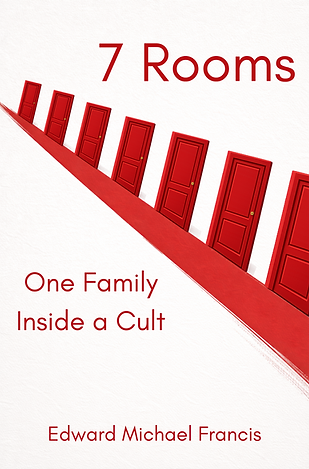.png)
Proposed Cover

Proposed Cover
7 Houses:
Confessions of a Cult Hopper
The family home was only the beginning. Picking up where 7 Rooms leaves off, 7 Houses examines the three decades that followed—a period where the high-control patterns of childhood didn’t disappear, but simply moved into new neighborhoods. This is a journey through the "adult cults" that felt like home because they were built on the same familiar foundations.
Moving through competitive performance groups, 1-on-1 domestic enclosures, and predatory professional ecosystems, the book traces how cult dynamics reassert themselves. Each "House" presented as something new while operating by the same invisible rules: Charisma replaced doctrine. Loyalty replaced belief. Compliance was reframed as growth.
Rather than offering a single endpoint, 7 Houses focuses on the mechanical reality of being a "Cult Hopper." It is a memoir about how patterns of control persist and adapt to different environments, and how difficult it is to name the system while you are still trapped within its walls. This is the story of continuity over closure—and the grueling process of learning to see the blueprint clearly enough to finally walk away.
7 Fields:
Edward's third book will focus on how their identity as a cult hopper affected their work life.
***More Soon!!***

About the Author

Edward Michael Francis (they/them) is a writer, critic, and cultural analyst whose work focuses on high-control systems, coercive power, and the subtle ways domination disguises itself as love, excellence, or belonging.
Edward’s life did not include a single cult experience, but a pattern of them. What began inside a family-based cult repeated across multiple environments over time — performance hierarchies, and professional worlds structured around obedience, surveillance, and moralized control. For years, these systems appeared unrelated. Only later did their shared logic become clear.
Their writing emerges from lived experience, not theory. These books were written after survival — during the long, deliberate process of recognizing patterns, reclaiming autonomy, and rebuilding a self that had been shaped by compliance rather than choice. Edward writes for readers who have sensed that something was wrong long before they had language for it.
Across 7 Rooms, 7 Houses, and Confessions of an Ex-Bando, Edward documents how control systems migrate, adapt, and persist — and how people can learn to see them clearly enough to leave. The work is personal, but its purpose is collective: to name what often goes unnamed, and to offer recognition to readers who may still be inside structures they haven’t yet been able to identify.
Edward is the creator of several podcasts including Marxists at the Movies, The Marching Revolution, and CultFroggy, and produces independent cultural criticism through CineMarch Media LLC.
CineMarch Media
"Revolutionary Ideas in Motion"
Privacy and Accessibility Policies
© 2025 CineMarch Media
All rights reserved.
We stand for artistic labor, radical honesty, collective ownership, and cat naps! 🐱💤