
🚨🚨Drum Corps International Consumer Warning: High Control, Six-Figure CEOs, and the Architecture of Abuse🚨🚨

To the casual stadium observer, drum corps is the pinnacle of youth achievement—military-grade precision and breathtaking athletic artistry. But for those who have lived it, there is a much darker reality. We call it the "Sentinel Species" perspective. Like a frog that breathes through its skin, the survivor is the first to sense when the environment turns toxic. While others are told they are simply experiencing the "rigors of tour," the Sentinel is the one noticing that the water is already boiling.
Below, you will find our comprehensive written brief mapping DCI's systemic practices onto global human rights frameworks, alongside a completely unique audio experience.
To tackle this massive mountain of research, we tried something brand new: an AI/human hybrid episode. We used Google NotebookLM’s Audio Overview feature to generate a deep-dive conversational breakdown of our data, which I frame, anchor, and guide with my own custom hosting segments to ensure the human element and emotional weight stay front and center.
🎧 Listen for Free: The full episode can be heard on the CineMarch Information Club page here: Listen on Patreon
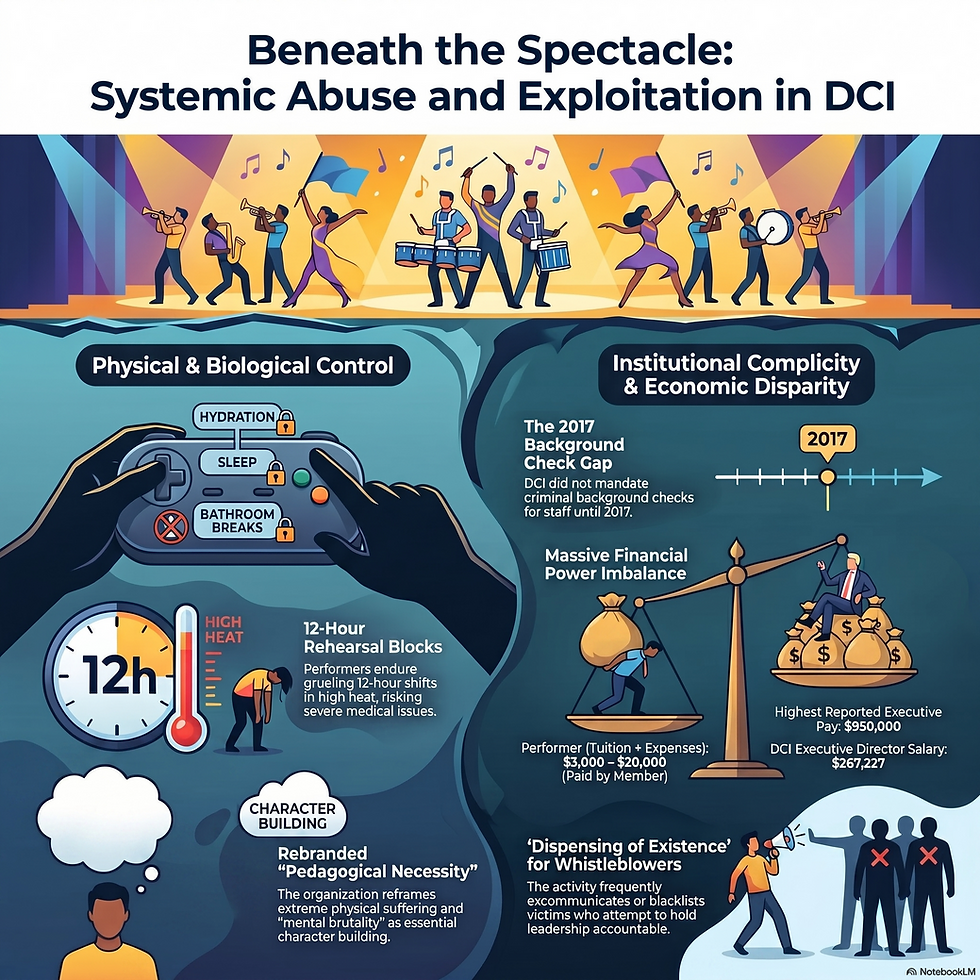
The Art of Exhaustion: Why the "Prestige" of Drum Corps Masks a Systemic Performance Cult
by Edward Michael Francis (they/them/theirs)
CultFroggy Podcast
Find the research in our: Google Notebook
For those of us who have lived it, there is another reality to drum corps. We call it the "Sentinel Species" perspective. Like a frog that breathes through its skin, the survivor is the first to sense when the environment turns toxic. While others are told they are simply experiencing the "rigors of move-ins," the Sentinel is the one noticing that the water is already boiling.
Every year, thousands of young performers pay thousands of dollars for the "privilege" of extreme physical and psychological suffering. Why do they do it? It isn't just about a love for music. Drum corps is a high-demand performance environment that maps directly onto academic models of totalism and thought reform. Under the guise of "excellence," the system uses a blueprint of high control to transform performers into deployable agents who have lost the cognitive machinery required to say "no."
1. The "Performance Cult" Diagnostic
To move from a gut feeling that "this is weird" to the realization that this is a documented system of control, we must apply the tools of social science. Three primary frameworks expose the architecture of the activity:
Robert J. Lifton’s Eight Criteria: Analyzes how groups control not only behavior but the internal monologue of the individual.
Steven Hassan’s BITE Model: Identifies control through Behavior, Information, Thought, and Emotion. It relies on cognitive dissonance: if a leader can get you to act in certain ways, your private beliefs will eventually shift to match the behavior.
Margaret Singer’s Six Conditions: Focuses on the social engineering used to keep members too busy and exhausted to reflect on their own transformation.
When these models are overlaid onto the drum corps experience, the "phantom of the opera mask" slips. As the data suggests, it stops being about the music and becomes about a system that prioritizes organizational doctrine over human welfare.
2. Milieu Control and the "Bob Barker" Rumor Mill
The foundation of any totalist system is milieu control—an information lockdown. The summer tour functions as a closed ecosystem. Isolated on buses and gymnasium floors, members lose access to external reality, making it nearly impossible to maintain a separate identity.
A classic illustration of this "fishbowl" nature is the "Bob Barker died" rumor. In the pre-smartphone era, veterans would tell rookies the famous host had passed away just to see how far the rumor would spread. Without Google in their pockets, members existed in a state of interpretive isolation where the corps was the only source of truth.
Today, the system has simply evolved. Rehearsal technology like UDB (Ultimate Drill Book) can be geofenced or require "airplane mode," and staff dictate the "authorized explanations" for any criticism members might find online. This is the creation of "Tour Goggles"—a distorted lens through which the member is taught to rationalize even the most egregious conditions.
3. Biological Policing: The Battle for the Bathroom
Behavioral control—the "B" in Hassan’s BITE model—begins with the regulation of basic bodily functions. Policing the body is the first step in shifting a performer’s private beliefs to match the organization's goals.
This manifests in the activity through the strict monitoring of bathroom access. In many corps, staff members literally time bathroom breaks; those who take too long are disciplined for a "lack of commitment." At the Reading Buccaneers, this policing took the form of ritualized hazing. On the bus, brass veterans would break into a rendition of "Duke of Earl," singing "Poop, Please Don't Poop" whenever a member used the onboard restroom. It sounds like a joke, but the function is clear: using social shame to restrict biological needs until the member learns to ignore their own body.
4. "Superman Mode" and the Science of a Hijacked Brain
What the activity celebrates as "Superman Mode" is actually a state of transient hypofrontality. Under conditions of chronic exhaustion, heat, and caloric deficit, the brain deactivates the prefrontal cortex—the area responsible for self-reflection and critical questioning—to conserve energy for rote execution.
This is exacerbated by Chronic Arousal. Tactics like the "Gush and Go"—where members must run for water and immediately sprint back to their set—prevent the parasympathetic nervous system from engaging. The brain remains trapped in a survival-based sympathetic hijack.
I lived this in 2001 during a parade in Lyens, PA. The heat was a physical weight. My vision narrowed, my body began to fail, but I didn't think, I need help. I thought, The judge’s box is coming up. When I eventually fell out, a staff member—Lou—approached me and said, "We’re approaching the judges' stand, you got to get back in." I rejoined, finished the parade, and then went directly into a six-hour rehearsal block. By the final run, I was fainting and vomiting. At the time, I felt "proud" of that adversity. That is the conversion process in action: the brain deactivates its ability to say "no," and the performer becomes an instrument for the organization’s "Sacred Science."
5. The Financial Abyss: Paying to Work
The financial structure of the activity reveals a staggering disparity. While we sip on our "Unpaid Labor Tea," it’s worth looking at where the money actually goes.
Member Costs: Performers pay $3,000 to $20,000 in tuition and travel fees to provide full-time labor that generates millions in revenue.
Executive Compensation: According to ProPublica, DCI executive compensation averages nearly 238,000*, with some figures reaching as high as *950,000.
"Kids are paying 20 grand for the privilege of having their bathroom breaks timed while the people at the top are clearing six or seven figures." In some cases, member tuition is quite literally paying for a director’s "fancy house," while the members themselves sleep on gym floors.
6. "Sacred Science" and the Dispensing of Existence
Lifton’s "Sacred Science" is the idea that the group's "way" is the ultimate truth. Questioning the process is framed as a character defect. I saw this firsthand when a 70-year-old mental health professional, nicknamed "Doc," attempted to physically swing at a performer. Why? Because the performer pointed to a score recap showing that another corps was rightfully beating us. When the ideology is threatened by facts, the response is explosive anger.
This culture of "Doctrine Over Person" leads to institutional silence regarding violence:
Gaslighting: Survivors reporting groping by instructors have been told their "religious upbringing" made them "too conservative."
Misconduct: Reports include "rookie talent nights" where minors were forced to witness sexual acts and adults urinating in public.
Whistleblower Retaliation: When I raised concerns about sexualized TikTok content filmed in private sleeping areas at the Boston Crusaders—content that attracted objectifying comments and represented a clear safeguarding failure—the response was telling. A Crossmen administrator immediately blocked me. DCI's ethics team claimed the issue would be addressed, yet the videos remained online, and no performers were removed from the field.
This is the "Dispensing of Existence." The system coaches members on how to "reduce visibility" (removing hashtags) rather than stopping the behavior. If you challenge the system, you are "not a teammate anymore," and your history is erased to protect the brand's reputation.
Conclusion: Beyond the Field
Drum corps uses "Loaded Language"—thought-terminating cliches like "Trust the process," "Suda," or "You knew what you signed up for"—to bridge the gap between your pain and their goals. But the excellence they sold you was never worth the price of your autonomy.
To transition from a "cult of excellence" to a model of authentic empowerment, the activity must dismantle its closed systems of logic. The question remains: Is the activity ready to practice the accountability it has preached to its members for decades, or is it just a business model with a brass line in front of it?
Survivor Toolkit & Resources
If you are a survivor seeking deconstruction support, you are not alone:
International Cultic Studies Association (ICSA): icsahome.com
People Leave Cults: peopleleavecults.com
Knitting Cult Lady (Daniellea Mastian Young): knittingcultlady.com
Crisis Lifeline (USA): Dial or text 988

The United Nations v. Drum Corps International: A Legal and Sociological Thought Experiment
By Edward Michael Francis (they/them)
CultFroggy Podcast
Introduction: The Sovereign Subculture
The international human rights apparatus—anchored by the United Nations, global treaties, and international tribunals—was built to hold sovereign governments accountable for the systemic abuse, exploitation, and subjugation of human beings. By design, non-profit youth organizations, amateur athletic leagues, and performance arts circuits slip through the cracks of this global framework, operating under local civil laws and domestic corporate governance.
However, certain contemporary institutions construct environments so insular, so rigid, and so all-encompassing that they effectively operate as micro-states. Competitive drum and bugle corps, governed under the umbrella of Drum Corps International (DCI), represents one such phenomenon.
To the casual observer, the marching arts represent the pinnacle of wholesome youth development, precision teamwork, and artistic excellence. But beneath the public-facing spectacle lies a multi-million dollar industry that relies on a "closed ecosystem". For several months each summer, young performers—many of them minors—enter a totalist environment characterized by geographic isolation, extreme physical duress, severe sleep deprivation, and intense psychological vulnerability.
This thought experiment strips away the specialized jargon, competitive prestige, and insular traditions of the activity to ask a fundamental question: If a member organization of Drum Corps International were a sovereign nation, and its summer tour a state-sanctioned program, how would its systemic practices stand up against international human rights standards? By mapping the lived experiences of performers and the institutional responses of leadership onto established global doctrines—such as the Convention on the Rights of the Child and the Convention Against Torture—we can construct a metaphorical legal brief.
This exercise evaluates the human cost of the "cult of excellence," measuring the systemic behaviors of the activity not against a competitive judging rubric, but against the foundational metrics of universal human dignity.
The following indictment outlines the formal charges a global prosecutor would bring against the governance of the activity...
1. Violations of the Convention on the Rights of the Child (CRC)
The UN CRC explicitly protects minors from economic exploitation, physical or mental violence, neglect, and abuse while in the care of caretakers or organizations.
The "Child Labor" & Financial Exploitation Paradox: Members pay massive tuitions (ranging from $3,000 to $20,000 per season) while top executives earn up to six-figure salaries. Yet, these paying "customers" endure 12-hour rehearsal blocks in extreme heat , essentially performing grueling physical labor under the guise of "education".
Failure to Protect from Abuse: The UN mandates that organizations protect children from all forms of physical or mental violence. DCI’s "well-documented history" of institutional complicity—where 11-year-olds and 14-year-olds were subjected to sexual violence on tour buses and in locker rooms, only for staff to brush off complaints or issue minor punishments like "running a lap"—would violate the core tenets of child protection.
2. Cruel, Inhuman, or Degrading Treatment
The UN Convention Against Torture (CAT) prohibits not just state-sanctioned torture, but any systemic "cruel, inhuman, or degrading treatment." In a totalist ecosystem like a summer tour, several common practices cross this line:
Weaponization of Biological Needs: Forcing a member to urinate on themselves on the field or ridiculing performers for needing a restroom break during medical emergencies (like an asthma attack) constitutes degrading treatment.
Extreme Sleep and Physical Deprivation: Operating under conditions of severe sleep deprivation , enforcing 12-hour rehearsal blocks in high humidity , and denying proper recovery for medical injuries (like severe sunburns or unhealed trauma) would be flagged as human rights overreaches.
Psychological Brutality and Hazing: Rituals like "compliance training"—where adults whisper erotic comments to 15-year-olds to test their flinch response —or forcing rookies to strip naked on moving tour buses would easily fit the international definitions of degrading psychological abuse.
3. The Architecture of Totalism & "Thought Reform"
While the UN doesn't have a specific "Anti-Cult Treaty," international law heavily protects the Freedom of Thought and Personal Autonomy.
A prosecutor would argue that DCI corps often use the architecture of a high-demand group to systematically strip away an individual's authentic identity. By implementing Milieu Control (complete isolation on a summer tour) , demanding unattainable purity , using public group confessions/punishments , and utilizing "loaded language" to stop critical questioning the activity overrides basic human autonomy.
4. "Dispensing of Existence" (Whistleblower Suppression)
Under international norms, organizations must provide safe avenues for justice. The drum corps activity has historically practiced what sociologist Robert Jay Lifton calls the "dispensing of existence" —effectively excommunicating, shaming, or blacklisting victims and whistleblowers who try to hold leadership accountable, while protecting the abusers to save face.
The Verdict
If DCI were a government, the UN would likely accuse it of running an authoritarian, closed ecosystem that uses psychological indoctrination and physical duress to exploit youth.
Historically, DCI's defense has been its fractured, weak organizational structure, operating merely as a "competition host" with independent member corps pulling the strings. But in our imaginary international court? "Lax hiring practices" and a "vague, toothless, ineffectual code of conduct" wouldn't save them from a guilty verdict on gross systemic negligence.


Brother, some of This stuff has nuggets of truth, but it’s interntwined with delusional paranoia coupled with an inability to accept criticism which is apparent from your comments being turned off on your Facebook page.