
MARXISTS AT THE MOVIES: Madonna: Truth or Dare (1991) - Machinery of Queer Extraction
- Edward Francis
- Feb 25
- 30 min read


By Edward Michael Francis (they/them)
Marxists at the Movies
Listen to the full episode here: https://www.youtube.com/watch?v=RyJ9vKJNnV4
Anti-Spoiler Warning: Gretta Garbo, and Monroe, spoiler warnings really blow. Marlon Brando, Jimmy Dean, Peoria thinks Madonna’s obscene. Grace Kelly, Harlow, Jean, queer folks get the guillotine. Gene Kelly, Fred Astair, history’s complicated sometimes and doesn’t always rhyme. Full plot details ahead.
My First Madonna
Madonna is my icon. There were others before her, and plenty who came after, but Madonna feels more personal. Like a Virgin was the first album I ever asked for and received on vinyl. I was six or seven—young enough that the request itself should probably have raised questions, old enough to know I wanted that record specifically. I didn’t have the language for why. I just knew the cover mattered. Her face mattered. The way she looked at the camera mattered. It felt illicit before I understood what sex or queerness even were. It felt like permission.
As I got older, Like a Prayer earned heavy rotation on the school bus—not officially, of course, but socially. Passed between kids, argued over, defended. The title track. “Express Yourself.” “Oh Father.” Songs that felt adult, dangerous, emotional in ways the rest of pop music wasn’t allowing yet. Later, Ray of Light would claim that same space—another bus, another era, another version of me still trying to survive adolescence while something in Madonna’s work kept insisting that transformation was possible, that reinvention wasn’t a betrayal but a skill.
Madonna wasn’t just music. She was orientation. For a queer kid growing up closeted in the Midwest, Catholic-adjacent and already fluent in subtext, she was proof that identity could be constructed rather than inherited. That refusal could be productive. Long before I had politics, I had Madonna.
So by the time I was seventeen, maybe eighteen, when I finally got my hands on Truth or Dare on VHS, I wasn’t approaching it cold. A friend had dubbed it—third-generation copy, tracking lines stuttering across the screen every time someone moved too fast. The box was unmarked except for the Sharpie scrawl: Madonna – Truth or Dare. “Don’t let your fuckin’ parents see this,” he told me, like he was passing contraband. In a way, he was.
This was 1998, maybe early ’99. The film had been out for years, but it still carried the mythology of danger. Madonna in 1991 wasn’t just provocative—she was a cultural problem. Condemned by the Vatican. Threatened with arrest. Treated as evidence that something had gone wrong. Watching Truth or Dare felt like crossing a threshold you weren’t supposed to cross, entering a space where power, sex, queerness, and control were all in play at once.
But here’s the thing: I already knew what Madonna meant. I didn’t need the film to tell me. By the time I pressed play, I had already internalized her as both sanctuary and spectacle. What I didn’t yet know—what the film would eventually teach me—was how tightly those two things could be bound together.
I’m writing this now not to retroactively judge a pop star working in 1990, but to examine what Truth or Dare actually is: not just a concert documentary, not just a provocation, but a record of how queer culture, labor, intimacy, and power were being organized at a very specific historical moment.
This is not a takedown. It’s not hagiography either. It’s an attempt to sit inside the contradiction without resolving it too quickly—to understand how something that felt like a lifeline could also function as a machine.
What follows is a Marxist reading of a documentary that mattered deeply to me, made by a woman whose work shaped me, about a tour that centered queer men in 1990—a year when being visibly queer could get you killed, fired, or erased.
The affection is real. The accounting comes later.
The Historical Moment: Why Truth or Dare Could Exist
To understand what Truth or Dare was doing in 1991, you have to sit inside the dread of 1990.
By the time Madonna’s Blond Ambition World Tour rolled through cities in the spring and summer of that year, AIDS had already killed nearly 60,000 people worldwide. In the United States alone, more than 40,000 people were living with HIV—numbers that felt staggering then and would only climb. The Reagan administration had spent the better part of a decade treating the crisis with a mixture of indifference and contempt, refusing to fund research, blocking education, letting an entire generation die while the government looked the other way. By 1990, AIDS had become the leading cause of death for men aged 25 to 44. For queer people, especially queer men, this wasn’t an epidemic—it was a holocaust.
ACT UP, the AIDS Coalition to Unleash Power, had been founded in March 1987 by playwright Larry Kramer and roughly 300 people who gathered at New York’s Lesbian and Gay Community Services Center, united in what Kramer described as anger and a commitment to nonviolent direct action. By 1990, ACT UP chapters had spread across the country and the world, staging protests that were equal parts grief ritual and street theater.
On May 21, 1990, more than 1,000 activists stormed the National Institutes of Health in Maryland, demanding more AIDS treatments and an end to the exclusion of women and people of color from clinical trials. On January 22, 1991—the same year Truth or Dare was released—activists invaded the CBS Evening News broadcast, shouting “Fight AIDS, not Arabs!” as the United States spent billions daily on the Gulf War while claiming there was no money for AIDS programs. The next day, ACT UP activists raised a banner in Grand Central Terminal that read “Money for AIDS, Not for War.” They chained themselves inside department stores. They wrapped Senator Jesse Helms’s house in a fifteen-foot condom.
They scattered the ashes of their dead on the White House lawn.
This was the political weather in which Madonna toured and in which Truth or Dare was released.
At the same exact cultural moment, the art world was being dragged through its own battle over what could be seen, said, or funded. In 1989, two exhibitions—Andres Serrano’s Piss Christ and Robert Mapplethorpe’s The Perfect Moment—had ignited what became known as the culture wars. Senator Jesse Helms, who had spent years blocking AIDS funding and spreading homophobic falsehoods about HIV transmission, led the charge against the National Endowment for the Arts. Congress passed restrictions prohibiting NEA funding for projects that might be considered obscene, explicitly naming depictions of sadomasochism and homoeroticism. In October 1989, the compromise bill mandated that no NEA funds could be used for materials depicting “homoeroticism” or “individuals engaged in sex acts” unless the work had “serious literary, artistic, political or scientific value.”
When The Perfect Moment opened at Cincinnati’s Contemporary Arts Center in April 1990, police forced 400 visitors to leave so they could videotape Mapplethorpe’s photographs as evidence. The museum’s director, Dennis Barrie, and the institution itself were indicted on obscenity charges. They were acquitted in October 1990, but the trial made one thing clear: queer visibility, queer art, queer bodies—all of it was being treated as a threat to public morality, something to be policed, censored, and prosecuted.
Into this climate of surveillance, censorship, and death, Madonna released a film that centered queer men. Not as victims. Not as tragic supporting characters. But as co-creators, collaborators, and the literal engine of the spectacle. She simulated masturbation onstage in a cone bra while police stood ready to arrest her in Toronto. She kissed a Black Jesus in a music video that drew condemnation from the Vatican and threats from religious groups. She made a documentary that featured voguing—a dance form born in Harlem’s Black and Latinx ballrooms—and refused to sanitize queerness for a straight audience.
Madonna’s timing wasn’t accidental. The Blond Ambition Tour ran from April to August 1990. Truth or Dare premiered in May 1991. The Erotica album and the Sex book followed in 1992. This was a deliberate strategy: transgression as product rollout, yes, but also transgression as genuine cultural intervention. She was testing what could be shown, what could be sold, what the market would bear. And she was doing it at a moment when showing two men in bed together could get a museum director criminally prosecuted.
But here’s the contradiction Madonna never resolved and Truth or Dare accidentally exposes: you can mainstream queer culture without liberating queer people. You can center queer men in your narrative and still extract their labor. You can be both smuggler and profiteer, both ally and employer. The film documents this in real time, whether Madonna intended it to or not.
Truth or Dare arrived in 1991 not as a simple act of allyship or appropriation, but as a capitalist document produced inside a state of emergency. The film captured something that mattered—queer visibility at a moment when visibility could mean death or prosecution—but it also captured the terms of that visibility: controlled, monetized, and always, always flowing upward toward the singular figure of Madonna herself.
The historical moment explains why the film could exist. It does not explain away what the film reveals about who benefits when queer culture goes mainstream.
The Film as Product: Concept, Construction, and Circulation
Madonna: Truth or Dare is, on its surface, a concert documentary. More precisely, it is a hybrid object: part tour film, part backstage diary, part star text, and part corporate self-mythology. Directed by Alek Keshishian, the film follows Madonna during the European leg of the Blond Ambition World Tour, cutting between full-color footage of the stage spectacle and black-and-white 16mm footage of rehearsals, hotel rooms, airports, and private encounters.
There is no traditional plot in the narrative sense. The film’s structure is episodic, organized around cities, performances, and interpersonal conflicts rather than a causal arc. What propels it forward is not story but accumulation: scenes of dominance, confession, discipline, and release repeating until a worldview coheres. Madonna performs. Madonna supervises. Madonna is challenged. Madonna reasserts control. The tour advances. The brand holds.
Formally, the film is built around contrast. The concert footage—shot in saturated color with multi-camera coverage—presents Madonna as untouchable icon: choreographed, armored, transcendent. The backstage footage, by contrast, claims intimacy through its black-and-white grain, handheld camerawork, and apparent spontaneity. This division is not incidental. It mirrors the film’s ideological claim: that we are being allowed behind the curtain, that access itself is the gift. But access here is tightly managed. What looks like exposure is, in fact, curation.
The production itself reflects this duality. Truth or Dare was shot over the course of the 1990 tour, with more than 200 hours of footage captured. Madonna served as executive producer and retained final cut, a fact that matters not just legally but politically. Director Keshishian has been candid in interviews about staging or provoking certain moments—most notably the encounter with Madonna’s childhood friend Moira McFarland—borrowing techniques that would later become standard in reality television. The film’s claim to vérité is therefore less about transparency than about control of affect: moments are engineered to feel raw, but only within boundaries Madonna authorizes.
Technically, the film was shot by a small crew, relying heavily on mobility and proximity rather than spectacle. Cinematographer Oliver Wood handled much of the backstage footage, while the concert sequences were captured with the infrastructure of a major arena tour. Editing was central to the film’s impact. Keshishian’s initial cut reportedly ran well over three hours; the released version, at 122 minutes, was shaped under pressure from Miramax, which acquired distribution rights. The final structure privileges rhythm and escalation over explanation, allowing power dynamics to surface indirectly rather than being stated outright.
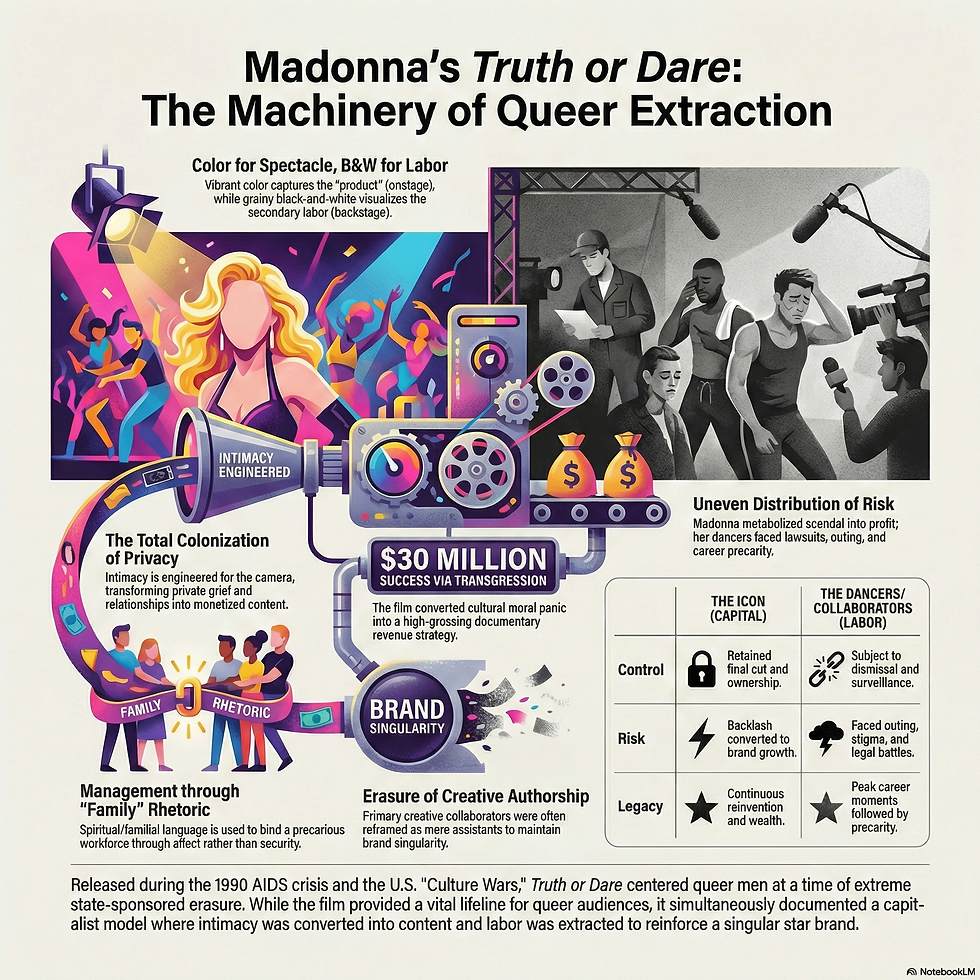
Financially, Truth or Dare was a striking success. Produced on a relatively modest budget—reported at approximately $4–5 million—the film grossed nearly $30 million at the U.S. box office alone, making it one of the highest-grossing documentaries of its time. Distributed by Miramax, then positioning itself as a tastemaker studio for “edgy” prestige fare, the film benefited from controversy as marketing. Bans, protests, and moral panic were not obstacles; they were accelerants. Transgression was not just aesthetic. It was revenue strategy.
Critically, the film was received as both revelation and provocation. Reviewers fixated on Madonna’s will to power, her refusal of sentimentality, her apparent coldness toward lovers and collaborators alike. What was less frequently interrogated at the time was how seamlessly the film aligned with late-capitalist celebrity logic: total access paired with total ownership, intimacy offered without reciprocity, and labor rendered visible only insofar as it reinforced the singular genius at the center.
In other words, Truth or Dare did not merely document a tour. It documented a mode of production. It showed how a pop star could convert every aspect of life—work, friendship, grief, sex, conflict—into content, while retaining exclusive control over how that content circulated and who profited from it. The film’s technical achievements and commercial success are inseparable from this logic. Its innovations are real. So are its hierarchies.
Understanding Truth or Dare requires taking it seriously as a constructed object: a film designed to look intimate while functioning as infrastructure. Only then can we see what it reveals—not just about Madonna, but about how queer culture, labor, and visibility were being reorganized at the dawn of the 1990s, just before reality television would make this model ubiquitous.
What the Film Is Formally Doing
Truth or Dare operates through a rigid formal grammar that divides the world into labor and spectacle, surveillance and intimacy, discipline and ecstasy.
Director Alek Keshishian’s most consequential structural choice is the film’s visual split: backstage footage shot in black-and-white 16mm, performance footage rendered in saturated color. On the surface, this reads as an aesthetic contrast—reality versus artifice. In practice, it establishes a hierarchy. Color is reserved for the product: the staged spectacle audiences pay for, the thing that generates capital. Black-and-white is for everything else: rehearsal, recovery, conflict, intimacy, breakdown. The labor that sustains the spectacle is visually coded as secondary, grainy, disposable.
The film tells you, without dialogue, what matters and what doesn’t.
That backstage material is not intimacy. It is surveillance. Cameras are never not present.
They are there during medical exams, emotional breakdowns, moments of exhaustion, moments of sex and vulnerability. They are there when Madonna is in bed with her dancers, whispering what she calls “words of wisdom.” They are there during her phone fight with Warren Beatty, her then-boyfriend, who becomes the film’s most accidental theorist. After mocking her refusal to turn off the camera during a doctor’s examination, Beatty cuts straight to the truth: “She doesn’t want to live off-camera, much less talk. What point is there of existing off-camera?”
It’s delivered as a joke. It isn’t one.
Beatty understands something the dancers cannot yet afford to: that for Madonna, the camera is not documentation. It is production. There is no off-camera self because there is no self that is not performing, not generating content, not feeding the machinery. The film frames this as access—look how close we’re getting—but Beatty names it correctly: the total colonization of private life by the logic of the brand.
Madonna knows this, too. After slamming down the phone and shouting, “What an asshole,” she doesn’t storm away. She turns to the camera. Smirks. She knows we’re watching. She knows the fight is content. She knows the anger, the vulnerability, the tears will be edited, scored, and sold. The smirk is both permission and warning: I am in control of this, and you are not.
This is not documentary as observation. It is documentary as performance. Moments that appear spontaneous are engineered for affect, cruelty allowed to surface when it serves the mythology. The result is not honesty, but legibility—Madonna as someone willing to be seen as cold, domineering, even monstrous, so long as she remains sovereign.
What the film constructs, consistently and without ambiguity, is Madonna as boss, confessor, priest, and warden. She leads her dancers in prayer circles before each show, hands clasped, invoking “the gods of thunder and lightning.” The ritual is sincere and cynical at once—spiritual language repurposed as management technique. She is the one they confess to.
The one whose approval they seek. The one who decides who stays and who goes. She calls them family, and in the logic of capital, that is exactly what they are: a labor force bound by affect rather than contract, where love replaces security and loyalty substitutes for protection.
The film invites us to love these dancers. To root for them. To feel moved by their humor, their fear, their queerness, their ambition. And we do. Jose, Luis, Oliver, Salim, Kevin, Carlton, Gabriel. They are electric, vulnerable, sharp, achingly human. The film gives them space to exist as themselves in a way almost no mainstream media did in 1990.
But it never lets us forget: they are replaceable.
Madonna disciplines them for breaking tour rules. She scolds them for going out without permission. She fires Gabriel mid-tour and replaces him. The show goes on—because the show is not theirs. It is hers. They are labor. She is capital.
The formal structure of Truth or Dare—color for spectacle, black-and-white for labor, cameras that never stop recording—is not merely stylistic. It is a Marxist blueprint. The film accidentally documents the precise mechanisms by which queer culture is transformed into profit: how bodies become instruments of accumulation, how intimacy becomes managerial leverage, how surveillance becomes a condition of employment.
Warren Beatty saw it. The dancers, in 1990, could not yet afford to.
Queer Labor on Display
The audition ad ran in Daily Variety and casting offices across New York and Los Angeles in late 1989: “Open Audition for FIERCE Male Dancers who know the meaning of TROOP STYLE, BEAT BOY and VOGUE… Wimps and Wanna-Be’s need not apply!”
What the young men who showed up didn’t know—couldn’t have known—was that they were auditioning not just for a tour, but for a documentary that would make them icons and then sue them for appearing in it.
Seven dancers were chosen. Six of them were queer men, most of them men of color. Jose Gutierez and Luis Camacho came from the ballroom scene, members of the legendary House of Xtravaganza. They brought voguing with them—not as artifact, but as lived practice, as cultural technology developed in Harlem’s Black and Latinx ballrooms where queer and trans people had been creating art forms for decades. Kevin Stea, Oliver Crumes, Salim Gauwloos, Carlton Wilborn, Gabriel Trupin. Their names matter. They were not props.
But Truth or Dare asks us to see them as family while never letting us forget they are workforce.
Madonna calls them her children. She holds their hands in prayer circles before every show, invoking gods and asking for protection. She listens to their confessions, their fears, their stories about coming out or staying closeted. She scolds them when they break curfew, when they sneak out to clubs, when they don’t follow the rules she’s established. In one scene, she gathers them in a hotel room and tells them, pointedly, that she wouldn’t hire gay men who hate women. “I kill fags that hate women,” she says, the slur delivered with the casual reclamation common in queer spaces of that era, but also with the unmistakable tone of a boss reminding employees that their employment is conditional on her approval.
The film wants us to feel the intimacy. And the intimacy is real—these men loved her, trusted her, believed they were building something together. Jose Gutierez would later say that he didn’t know how to process the relationship, that Madonna felt almost like a mother to them, that the love was real even if the business wasn’t. He continued working with her after the tour but eventually rebelled because he couldn’t understand why the attention had shifted, why they were being pushed aside. He took it personally because it was personal. That’s how capital works when it wraps itself in the language of family.
But underneath the familial rhetoric was a different structure entirely: contracts, precarity, discipline, replacement.
Gabriel Trupin was fired mid-tour. The film barely registers this. One scene he’s there, the next he’s gone, replaced without explanation or mourning. When the 2016 documentary Strike a Pose reunited the surviving dancers twenty-five years later, they spoke about Gabriel’s absence—he had died of AIDS-related complications in 1995—as an unhealed wound. His firing, his erasure from the tour, the fact that the machinery simply continued without him: all of it reinforced what they already knew but couldn’t yet name. They were not irreplaceable. The show was not theirs. It belonged to the woman at the center, and they existed in orbit, subject to gravitational pull or expulsion depending on her needs.
When Truth or Dare was released in May 1991, three of the dancers—Kevin Stea, Oliver Crumes, and Gabriel Trupin—sued Madonna and the film’s producers. The lawsuit was framed in the press as invasion of privacy, as if the dancers were ungrateful or prudish, uncomfortable with their own queerness being shown onscreen. But that framing was a distortion, one the dancers have spent decades trying to correct.
Kevin Stea explained in a 2017 interview with HuffPost that the lawsuit was fundamentally about contracts, not morality. Oliver Crumes and he were suing because there was a clause in their contract for the movie, and Madonna didn’t honor it. Gabriel’s situation was different and far more painful: he had been told specifically that anything he didn’t want in the film would not be in the film, and he had one request—don’t include the kiss between him and Salim. They put it in anyway.
Gabriel had a boyfriend. The boyfriend had a son. After Truth or Dare was released, that child was bullied and attacked at school. Gabriel’s mother, Sue Trupin, would later say in Strike a Pose that her son’s outing wasn’t a statement he wanted to make—it was Madonna’s statement. Gabriel had no control over how his image, his body, his intimacy would be used. The film took what it needed and left him to manage the consequences.
Kevin Stea has said he doesn’t regret the lawsuit. In fact, he’s proud of it. He saw it as standing up for himself, for his community, for dancers’ rights. The choice to sue, he said, came from asking himself what Madonna would do in his position. She had always told him not to let people take advantage of him. So he didn’t. The irony, apparently, was lost on no one.
The case settled out of court in 1994. We don’t know the terms. What we do know is that the dancers were asked to perform emotional labor alongside physical labor. They were asked to be vulnerable, to confess, to expose their lives and relationships for the camera. And when they asked to be compensated fairly or to have control over how that vulnerability was used, they were painted as litigious, difficult, bitter.
This is the machinery of extraction in its purest form: take the labor, deny the workers ownership, and when they object, reframe their resistance as betrayal.
Truth or Dare does something genuinely radical by centering queer men in 1990. It shows two men kissing in bed. It shows voguing. It shows gay pride parades and queer intimacy without apology or sanitization. For closeted kids watching in the early ’90s—kids like the one writing this essay—it was a lifeline. The dancers know this. They’ve spoken about it for years. They understand the cultural impact of what they did, how many lives they touched, how rare it was to see queer men treated as fully human on that scale.
But the film also shows us, whether it meant to or not, that visibility is not liberation. That representation without redistribution of power is just aesthetics. That you can love your workers and still exploit them. That Madonna could give these men a global platform and still treat them as fungible, replaceable, subject to the logic of the bottom line.
Christopher Ciccone and the Question of Intellectual Theft
Christopher Ciccone died on October 4, 2024, from pancreatic cancer, two weeks after the death of his and Madonna’s stepmother, Joan. He was 63. Madonna posted a tribute to Instagram that described him as the person who understood her best, someone whose impeccable taste she’d always sought approval from. She said they’d found their way back to each other before he died.
This reconciliation matters because for nearly a decade, the two had been estranged—not over creative differences, but over money, recognition, and the question of whose vision shaped one of the most iconic tours in pop history.
Christopher was the art director for the Blond Ambition World Tour. Not a consultant. Not an assistant. The art director. He’d been working with Madonna since 1982, when he moved to New York to support her emerging career as her backup dancer. He appeared in the music video for her single “Lucky Star” in 1984, performed on her early television appearances, worked at the Italian boutique Fiorucci, and eventually became her dresser as her fame grew and she embarked on arena tours. In 1989, he created the artwork for the twelve-inch version of her single “Like a Prayer.”
By 1990, Christopher wasn’t just Madonna’s brother—he was one of her primary creative collaborators. And then came Blond Ambition.
In his 2008 memoir Life with My Sister Madonna, which debuted at number two on The New York Times Best Seller list, Christopher described a working relationship built on intimacy, trust, and systemic exploitation. He claimed Madonna demeaned and underpaid him throughout their professional partnership, a pattern that extended across years and multiple tours. In interviews promoting the book, he didn’t soften his language: she was cheap, he said, despite having the highest female annual income in Britain in 2001—$43.8 million—and a net worth estimated at $260 million. She treated him, he wrote, like nothing more than a serf paid to decorate her house.
The money dispute was compounded by something deeper: the question of creative authorship. Who designed the cone bra? Who conceptualized the staging? Who turned a concert tour into a piece of multimedia theater that influenced every pop spectacle that followed? Christopher’s position was that Madonna couldn’t tolerate shared authorship once the brand demanded singularity. She needed to be seen as the sole creative genius, and anyone who threatened that mythology—even her own brother—had to be diminished, underpaid, or erased.
Christopher told Good Morning America in 2008 that the turning point in their relationship came when Madonna brought cameras to their mother’s grave for Truth or Dare. He’d kept his feelings inside at the time, but the moment changed his understanding of her permanently: there were no boundaries now. Their mother had become a bit player in Madonna’s life story, reduced to content, to mythology, to brand. It hurt him. And his opinion of her altered in that moment, though he never said anything about it until the book.
This is where the story becomes structurally familiar: a queer family member provides essential creative labor to build an empire, and when that empire becomes too profitable to share, the labor gets reframed as assistance rather than authorship. Christopher’s claims about being underpaid and demeaned are not legal accusations—he settled whatever disputes existed privately, and both siblings eventually reconciled. But the pattern he describes is instantly recognizable to anyone who’s watched how capital metabolizes creative collaboration.
What makes this different from the dancers’ lawsuit is kinship. The dancers were employees who could be replaced. Christopher was family—literally—and his role blurred the line between collaboration and subordination in ways that made extraction feel like love. Madonna lent him $200,000 to buy a painting studio. She encouraged him to keep creating. She brought him into her world when he was young and gave him opportunities most people never get. And she also, according to Christopher, perpetually underpaid him, disputed payments, and later had him blacklisted from Hollywood after the memoir was published.
Both things can be true. Generosity and exploitation are not opposites under capitalism—they are often two sides of the same transaction.
Christopher was careful in interviews to avoid sounding bitter. In 2017, he told Fox News that there wasn’t a single word in his book that wasn’t true—if it hadn’t been, he would have been sued for defamation. He didn’t write the book to paint Madonna as a villain, he explained. He wrote it because he wanted a little recognition. He wanted people to think of him as a creative person, as an artist, not just as Madonna’s brother—a tag he knew he’d wear forever, but hoped might someday become secondary to his own name.
Madonna’s longtime publicist, Liz Rosenberg, told the Associated Press that Madonna found it very upsetting that Christopher had decided to sell a book based on his sister, and assumed the book would remove any chances of them ever having a close relationship again. But by 2012, Christopher was telling CBS News that their relationship was fine as far as he was concerned. They were emailing. They were back to being brother and sister. He didn’t work for her anymore, and it was better that way.
What happened between 1990 and 2008—between the Blond Ambition Tour and the publication of the memoir—is a case study in how creative labor disputes inside families get subordinated to brand management. The question isn’t whether Christopher contributed essential creative vision to Blond Ambition. The historical record shows he was the art director. The question is whether Madonna’s empire could tolerate shared authorship once it threatened brand singularity.
The answer, based on Christopher’s own account, is no.
This isn’t about vilifying Madonna or sanctifying Christopher. It’s about recognizing that even within families—especially within families—the logic of capital finds a way to turn collaboration into hierarchy, intimacy into management strategy, and kinship into a contract that only one party can afford to break.
Christopher said he thought Madonna was ultimately a lonely person, and that it truly is lonely at the top. Maybe that’s true. But loneliness at the top is a choice made possible by pushing everyone else down.
In September 2024—just weeks before Christopher’s death—Madonna appeared on Jay Shetty’s podcast and discussed their reconciliation. Her framing is worth examining closely. She described Christopher as someone she perceived as her biggest enemy, someone she hadn’t spoken to for years. When he got sick and reached out saying he needed help, she had to ask herself whether she would help her enemy. She talked about the relief she felt, the weight lifted, the baggage she could put down. She said forgiveness was important, that being in a room with him and holding his hand—even if he was dying—and saying she loved him and forgave him was really important.
Notice the architecture of that language: she forgave him. She felt relief. She put down baggage. She found peace.
There is no acknowledgment in that framing of what Christopher claimed: systematic underpayment, creative labor theft, being accused via email of swindling her after twenty years of loyalty, being blacklisted from Hollywood after the memoir was published. Madonna’s public statements about their reconciliation focus entirely on her spiritual growth, her generosity in forgiving someone who had wronged her, her magnanimous decision to help her dying brother despite perceiving him as an enemy.
Christopher, for his part, seemed to accept this framing. By 2019, he told Radar Online they were at peace and had spoken recently. He’d moved back to Michigan, closer to family. He never demanded a public apology or acknowledgment of the labor disputes. He reconciled on her terms because those were the only terms available.
This is how power works inside families under capital: the person with leverage gets to write the narrative of reconciliation. Madonna could frame herself as the forgiving party, the spiritually evolved one, the sister gracious enough to hold her dying brother’s hand. And Christopher—who had written a memoir just to get a little recognition, who spent decades building her empire, who claimed he was systematically exploited—had to accept that framing if he wanted a relationship with his sister before he died.
They reconciled. She held his hand. She said she loved him. And she never once, in any public statement, acknowledged that maybe—just maybe—he had legitimate grievances about how his creative labor was compensated, credited, and remembered.
Forgiveness happened. Accountability did not. And the difference between those two things is the difference between personal healing and structural change.
Christopher forgave her, or perhaps he simply let it go because he was dying and wanted peace. Madonna forgave him for crimes he may or may not have committed against her mythology. They found their way back to being brother and sister.
But the machinery that allowed one sibling to accumulate wealth, fame, and narrative control while the other had to write a memoir just to be seen as a creative in his own right? That machinery kept running, right up until the end.
Erotica, Sex, and Who Absorbs the Risk
On October 21, 1992—one day after the Erotica album dropped—Madonna released Sex, a coffee table book wrapped in mylar like a condom, spiral-bound in aluminum, priced at fifty dollars, and filled with photographs by Steven Meisel that the Vatican denounced before they’d even seen it. The book sold 150,000 copies on its first day and topped The New York Times bestseller list for three weeks. Within days, it had moved 1.5 million copies worldwide, making it the fastest-selling coffee table book in history.
It was also banned in Japan, India, and Ireland. Southern Baptists threatened to pull their $2.1 million printing contract with the publisher. Citizens in Alexandria, Louisiana, filed obscenity complaints with local police. The tabloid press ran eight-page spreads of the images they claimed were repulsive, calling Madonna a narcissist, a shameless exhibitionist, someone whose career had finally crossed the line from provocateur to pariah.
The backlash was vicious, unprecedented in its scale and vitriol. And Madonna survived it.
Of course she did. She had the infrastructure to survive it. She owned Maverick, her own imprint. She had Warner Brothers backing her. She had money, lawyers, publicists, a brand built on transgression that could metabolize scandal into sales. When the smoke cleared, she’d made millions. She moved on to Bedtime Stories, then Ray of Light, reinventing herself as a spiritually enlightened earth mother, wiping the slate clean every few years because that’s what stars with capital do: they get to start over.
But here’s what Sex and Erotica revealed about the machinery of sexual liberation under capitalism: risk is unevenly distributed.
Madonna could simulate masturbation onstage, publish a book featuring sadomasochism and queer desire, and walk away relatively unscathed because she controlled the means of production. She owned her image. She had final cut. She could weather a few years of bad press because the empire was already built, the fortune already made, the legend already cemented.
Her dancers could not.
Three of them—Carlton Wilborn, Salim Gauwloos, and Gabriel Trupin—were secretly living with HIV during the Blond Ambition Tour. None of them knew about each other’s status. The stigma was so intense, the fear so pervasive, that even within the so-called family Madonna had built, these men could not tell each other they were dying. Gabriel Trupin would be dead by 1995.
Kevin Stea has said he wasn’t even fully out to himself during the tour. He was questioning, experimenting, trying to figure out what it all meant while cameras filmed him constantly and Madonna told him to be himself, be bold, push boundaries. When Truth or Dare came out, he was outed to the world before he’d fully come out to himself. He’s also said he didn’t want to appear as though he’d used Madonna’s name to get ahead and then sued her for money—so for years, he didn’t talk about the tour publicly. He just dealt with it alone.
Gabriel Trupin had already asked—explicitly—that the kiss between him and Salim not be included. It was included anyway. After Truth or Dare was released, the consequences landed where they always do: on the people without control. His boyfriend’s son was bullied and attacked at school. Years later, Gabriel’s mother, Sue Trupin, would say in Strike a Pose that her son’s outing wasn’t a choice he made. It was a choice made for him. When Gabriel objected, director Alek Keshishian later claimed Madonna told him to “get over it.”
Several of the dancers developed drug addictions after the tour. Jose Gutierez has spoken about how he thought he was going to die from AIDS anyway, so why bother applying for a work visa, why plan for a future that didn’t exist? His mother admitted in Strike a Pose that she’d expected him to be more successful after landing the Madonna gig. The tour was supposed to be the beginning of something. Instead, for most of them, it was the peak—a single job that defined their entire careers, a moment frozen in pop culture memory that they spent thirty years trying to move past.
Meanwhile, Madonna released Sex and moved on.
The book itself is fascinating as an artifact of what sex positivity looks like when it’s been fully colonized by capital. Madonna wrote it as “Mistress Dita,” a character inspired by 1930s film star Dita Parlo. The images were influenced by punk rock and fashion photographers like Helmut Newton and Robert Mapplethorpe—the same Mapplethorpe whose work had been prosecuted for obscenity just two years earlier. The book opens with a disclaimer about AIDS: “This book does not condone unsafe sex… safe sex saves lives.” It features cameos by Naomi Campbell, Big Daddy Kane, Vanilla Ice, Isabella Rossellini. It’s queer, kinky, boundary-pushing, and relentlessly commodified.
The book doesn’t liberate sexuality—it packages it. It doesn’t redistribute power—it consolidates it. Madonna isn’t giving queer culture to the world; she’s selling it back to the world at a $50 price point, wrapped in mylar, designed by fashion’s elite, photographed by Vogue’s Steven Meisel, with Madonna owning the copyright, the narrative, the final say.
And when the backlash came—when the Vatican condemned it, when police investigated whether it violated obscenity laws, when critics called her a whore, a witch, a heretic, the devil—Madonna absorbed it because she could afford to. The brand was built to withstand scandal. Transgression was the product.
But the dancers? They couldn’t afford it. Gabriel Trupin couldn’t afford to be outed. Kevin Stea couldn’t afford the years of litigation. The men living with HIV couldn’t afford to be publicly associated with the virus in an era when even touching a queer person was considered dangerous. Carlton Wilborn has spoken about how terrified he was of being branded as “that dancer guy,” because if people knew he was a dancer, they’d assume he was gay, and if they assumed he was gay, they’d assume he had AIDS, and then his career—his life—would be over.
This is the fundamental problem with treating sexual liberation as a consumer product: it works great for the people who own the product. For everyone else, visibility without structural protection is just exposure. Representation without redistribution of power is just risk.
Madonna later defended Sex by saying she was doing what women have been doing since the beginning of time. She said critics tried to shame her for empowering herself as a woman, that she spent years being interviewed by narrow-minded people who couldn’t handle images of men kissing men, women kissing women, and her kissing everyone. In 2003, she said she wasn’t apologizing in any shape or form, that the book explored every aspect of sexual fantasy and should be considered art.
And you know what? She’s not wrong. Sex was groundbreaking. It did push boundaries. It did make space for conversations about desire, queerness, and female sexual agency that the culture desperately needed. The problem isn’t that Madonna made the book. The problem is that she made it inside a system where the profits flowed upward and the consequences flowed down.
When Erotica was released alongside Sex, critics panned the album. It got overshadowed by the book, by the scandal, by the media circus. Madonna herself would later say she regretted releasing them simultaneously—not because Sex was wrong, but because Erotica got overlooked, and she loved that album. Her regret wasn’t about the harm done to others. It was about her work not getting its due.
The pattern of extraction and disposal extended beyond the dancers. Junior Vasquez—the legendary DJ who introduced Madonna to voguing at Sound Factory, who was an honorary member of the House of Xtravaganza, who remixed her Bedtime Stories album—learned this the hard way.
Vasquez and Madonna were close. She frequented his residency at Sound Factory, sitting on the giant speakers, whispering song requests in his ear between tracks. According to a 2005 interview with Higher Frequency, if he played something she didn’t like, she’d hold her nose and squeal “Stinky!” At a 1995 party for Bedtime Stories, Vasquez held her hand because she didn’t want to face the crowd alone. When MTV News asked what she found special about his DJing, she said it was his soulfulness, his feel for what people want to hear.
It was at Sound Factory that Madonna picked Jose Gutierrez and Luis Camacho from the voguing runway—members of the House of Xtravaganza—to appear in her “Vogue” video and tour with Blond Ambition. Vasquez had given her access to ballroom culture, introduced her to the scene, provided the literal dancers who would help make her the most famous woman in the world.
Then, in 1996, Vasquez released a track called “If Madonna Calls.”
The song sampled Madonna’s voice from his answering machine: “Hello Junior, this is Madonna. Are you there? Call me in Miami.” He chopped it up, layered it over a hard house beat, and turned it into what ballroom culture calls a “bitch track”—a song designed to read, to throw shade, to humiliate its target publicly. The track became a hit, reaching number two on the Billboard Dance Club Play chart and causing absolute mayhem in New York nightlife. Vasquez played it multiple times a night at peak hours in clubs where Madonna herself was known to appear. Clubbers would turn to each other and gasp, “I can’t believe he’s doing this!”
The story varies depending on who tells it. Some say Madonna didn’t show up for a surprise performance at one of Vasquez’s parties at the Tunnel and the song was his revenge. Others claim she fired him for “ruining” her Bedtime Stories remixes and this was his response. What’s undisputed is that Madonna did not approve of the track’s release, that she never gave permission for her voice to be used, and that their friendship and professional relationship ended immediately.
Madonna’s longtime publicist Liz Rosenberg told New York Magazine in 2003: “I can assure you that Madonna will never work with Junior again.”
And she didn’t. For years, anyway. In 2003, Vasquez remixed “Hollywood” for a Versace show in Milan—a brief thaw, quickly refrozen. By 2018, when Vasquez spoke to Hornet, he said he hadn’t had any correspondence with Madonna since “If Madonna Calls” dropped. He said he thought if they worked together again, it would blow up the whole community, but he didn’t know if her head was there. He said, with what sounds like genuine affection even after two decades of silence: “I live for that bitch, trust me.”
But Madonna had moved on. She had other DJs, other remixers, other sources of queer cultural capital to mine. Junior Vasquez—the man who introduced her to the dance form that would define one of her biggest hits, who gave her access to the Houses that would provide her dancers, who crafted remixes that made her albums club-ready—was disposable the moment he asserted ownership over his own work, his own voice, his own narrative.
The irony is almost too perfect: Madonna built a career on appropriating queer culture, and when one of the queer men who facilitated that appropriation used her voice without permission—the exact thing she’d been doing to ballroom culture for years—she cut him off permanently. The difference, of course, is power. Madonna had lawyers, publicists, a global brand. Junior had a nightclub residency and a sampler. She could afford to burn the bridge.
He couldn’t.
Gabriel Trupin died in 1995. His mother later said she had no idea how important Truth or Dare had been to gay men’s self-acceptance and validation until after his death, when people kept telling her how much the film had meant to them. She believes Gabriel would have eventually been proud of the role the film played in helping queer men around the world.
Maybe. Or maybe Gabriel would have preferred to control his own story, to come out on his own terms, to not have his intimacy turned into content without his consent, to not have his boyfriend’s son bullied because Madonna needed that kiss in the film.
We’ll never know. Gabriel’s dead. Madonna’s worth hundreds of millions of dollars. And the machinery that made both of those things possible is still running.
Returning to the VHS
I still have that third-generation copy somewhere—the one with the tracking lines and the Sharpie label. I haven’t watched it in years. I don’t need to. Truth or Dare doesn’t live on a tape anymore. It lives in my body. Certain images never leave: the cone bra, the prayer circle, the grainy backstage footage bleeding into saturated spectacle. Once you’ve seen it, you carry it.
What I couldn’t see at seventeen—what the film itself couldn’t fully name—was the machinery underneath. I saw the intimacy. I saw the queerness. I saw men centered, unapologetic, allowed to exist loudly at a moment when that visibility still felt dangerous. For a closeted kid in the Midwest in the mid-’90s, that mattered. It mattered enormously.
Madonna gave me that. I won’t pretend she didn’t.
And I loved the film—not defensively, not ironically, but genuinely. Truth or Dare captures Madonna at the absolute height of her powers: imperious, irreverent, funny, cruel, self-aware. We meet her as a nightmare—snapping at her crew, furious about sound levels, openly demanding—and the film never rushes to soften her. It lets the diva stand. As the tour unfolds, the logic sharpens: the obsession with monitors, with control, with precision isn’t arbitrary. For Madonna, entertainment isn’t metaphorically life or death. It is life or death. Everything is subordinated to that belief. This isn’t chaos. It’s discipline.
That’s why the concert footage is treated with such reverence. You can feel her pride in it, her protectiveness. The performances aren’t interruptions; they’re the justification. The Blond Ambition show is filmed as culmination—exact, theatrical, alive. The transition from “Live to Tell” into “Oh, Father” remains one of the most unsettling and deliberate pieces of staging in pop performance: Catholic iconography collapsing into erotic transgression, incense swinging, piety curdling into desire. It’s dizzying by design.
And then there’s the closer. No matter how many years pass, my body still responds to “Keep It Together.” The funk, the insistence on chosen family, the idea of kinship as survival. Ending there feels intentional in the deepest sense—belief and branding briefly aligning. Queer aesthetics, queer kinship, movement as communion. It works. It still works.
That’s what makes the reckoning unavoidable.
Because now I can see what I couldn’t then: that the beauty, the liberation, the visibility were produced inside a system that concentrated control upward and distributed risk downward. That the same film that made me feel less alone also documented how easily labor, intimacy, and loyalty become resources once they’re pulled into a brand.
This is not a moral indictment of Madonna as a person. It’s an analysis of Madonna as a function. She understood the machinery earlier than most and used it with ruthless clarity. She owned her image. She controlled the narrative. She turned transgression into infrastructure. And because she did, she survived scandals that would have destroyed anyone without that control.
Others did not have that option.
That’s the contradiction Truth or Dare leaves us with—and the one it never resolves. Visibility can be real and still be dangerous. Representation can save lives and still extract value. You can change the culture and still reproduce its hierarchies. Liberation and harm can be generated by the same process, the same film, the same woman.
I don’t regret that VHS. I don’t regret loving this film. Truth or Dare taught me that queer people could be powerful, visible, unapologetic. That lesson mattered. It still does.
But I also see now what that lesson cost—and who paid it.
The film is a masterpiece. It’s also a warning.
Both things are true. And if you can’t hold them at the same time, you’re not ready to understand how liberation works under capitalism—or why it so often fails the very people it claims to free.
Hammer and Sickle Rating: 3.5 out of 5 An essential queer document—and a highly calculated one that made one woman rich while others absorbed the risk.


Comments